Home › Places › Wat Phichai Songkhram
Wat Phichai Songkhram, Ayutthaya: where Phraya Tak's breakout through the Burmese siege began
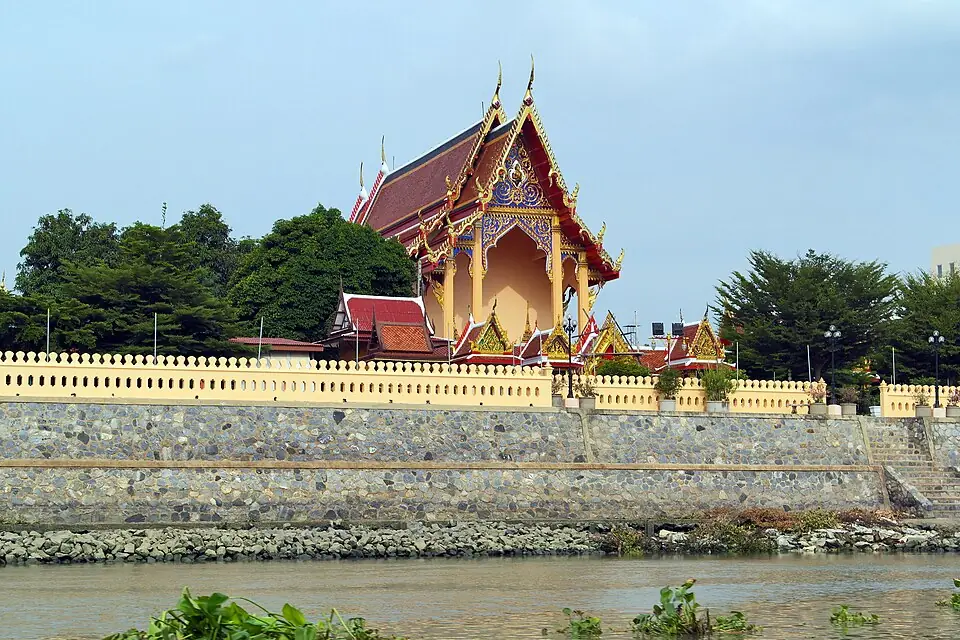
Wat Phichai Songkhram stands on the east bank of the Pa Sak River, not far from Ayutthaya railway station. In the Ayutthaya period it was called Wat Phichai. This was Phraya Tak's last camp in the war of the second fall, and the starting point of his breakout through the Burmese siege on the evening of 3 January 1767, about three months before the city fell. The march that began at this temple led to the recovery of the capital ten months later, which is why local people added the word Songkhram, "war", to the temple's name.
This place through the periods
A temple on the east bank of the Pa Sak River, then called Wat Phichai. The buildings you see are late Ayutthaya in style, with a large ubosot and wihan. Some researchers cite a copper plate indicating that the temple was built or restored not long before the war.
After the battle of Wat Sangkhawat in November 1766, Phraya Tak moved his camp to Phraya Phetchaburi's former camp near Wat Phichai. On the evening of Saturday 3 January 1767 he led some 500–1,000 soldiers (sources give different figures) out through the Burmese siege from here, east along Khlong Khao Mao. Local tradition says Phraya Tak came to pray at the temple before setting out.
While King Taksin was gathering forces at Rayong and Chanthaburi, Wat Phichai lay within the lines held by the Burmese until the city fell, and it was deserted along with the city.
In the Thonburi years villagers came back to settle along the Pa Sak River again, and the story of King Taksin's breakout was handed down in this neighbourhood.
A working temple with resident monks. In the Rattanakosin period local people added the word "Songkhram" (war) to its name, in memory of this being the starting point of the recovery of the nation. People come to pay respect to the Buddha and to remember King Taksin.
From Wat Yai Chai Mongkhon to Wat Phichai
After Phraya Phetchaburi's flotilla was broken at Wat Sangkhawat in November 1766, Phraya Tak moved his force to Phraya Phetchaburi's former camp near Wat Phichai, on the east bank of the Pa Sak River, outside the city wall on the east side. By then the city had bricked up its gates and was short of supplies, and it was plain that the Burmese would not withdraw in the flood season as in earlier wars.
The soldiers with Phraya Tak included Siamese and Chinese, and there is a record of Portuguese soldiers in his army in 1767–1768. The leading officers who followed him included Luang Phichai Asa, Luang Phrom Sena, Khun Aphai Phakdi and Muen Ratcha Saneha.
The evening of 3 January 1767
Kampol Champapan's chronology in Silpa Wattanatham magazine calculates from the chronicles that Phraya Tak left Wat Phichai on Saturday, the 4th day of the waxing moon of the 2nd lunar month, which is 3 January 1767 by the modern reckoning. The force broke through the Burmese lines and followed Khlong Khao Mao to the east. The next evening, at Ban Khao Mao, he saw the fire in the city turning the sky red. The following day they passed Wat Sam Bandit, fought the Burmese at Ban Pho Sao Han and ambushed a Burmese force at Ban Phran Nok.
Local tradition says that before setting out Phraya Tak came to pray at Wat Phichai, and that villagers along the route brought him khao mao (pounded young rice) and arrows. These stories are oral tradition and do not appear in the chronicles, but they show how the communities along the route remember the event.
Flight or orders
The Thai chronicles tell of Phraya Tak's departure from the capital as if it were his own decision, which has raised the question of whether he was abandoning the city. But articles in Silpa Wattanatham that use foreign evidence, such as Dutch letters, propose that the breakout may have followed a royal order to go out and find forces to relieve the capital. The matter is not settled. What is agreed is that having a force outside the siege made it possible to recover the country quickly after the city fell.
Visiting Wat Phichai Songkhram
The temple still has monks in residence. Its buildings are late Ayutthaya in style, with a large ubosot and wihan. It is close to Ayutthaya railway station, so if you come by train you can walk. See it together with Wat Yai Chai Mongkhon, about 1.5 kilometres to the south, then drive along the Ayutthaya–Uthai road to see the line along which Phraya Tak's force broke out, as far as the Ban Phran Nok Memorial in Uthai district, where the province holds a commemoration every 4 January.
Where historians still disagree
- Flight or orders: the Thai chronicles tell it as his own decision; some foreign sources suggest he may have been ordered out.
- The number of men: the Memoirs of Princess Narinthewi say about 500; the royal chronicles say about 1,000.
- The date: old documents record the year as BE 2309 because the new year began in the fifth lunar month; the same day in the modern reckoning is 3 January 1767 (BE 2310). Some English-language works use 4 January, the day the Burmese lines were broken through.
Visiting information
- It is a working temple with resident monks: dress modestly and behave with restraint.
- It is close to Ayutthaya railway station; you can come by train and walk from there.
- Go on to Wat Yai Chai Mongkhon (about 1.5 km), or drive to the Ban Phran Nok Memorial in Uthai district along the breakout route.
Frequently asked questions
On what date did Phraya Tak break out through the Burmese siege?
On the evening of Saturday 3 January 1767 by the modern reckoning, breaking through the Burmese lines on 4 January.
Why do some documents give the year as BE 2309?
At that time the new year began around April, so January still counted as BE 2309. By the modern reckoning it is BE 2310, that is, 1767.
Where is Wat Phichai Songkhram?
On the east bank of the Pa Sak River, in Kamang subdistrict, near Ayutthaya railway station.
- From Ayutthaya to Thonburi: A chronology of key events in the life of King Taksin – Silpa Wattanatham (in Thai)
- Foreign evidence on the last days of Ayutthaya: Phraya Tak broke out "on orders" – Silpa Wattanatham (in Thai)
- Wat Phichai Songkhram - Ayutthaya Historical Research
- Ayutthaya holds a wreath-laying ceremony for King Taksin at Ban Phran Nok – Manager Online (in Thai)
Last updated 13 November 2026