Home › Campaign routes › The capture of Chanthaburi: smashing the rice pots
The capture of Chanthaburi: smashing the rice pots
After the capital fell on 7 April 1767, the governor of Chanthaburi, who had promised to join in recovering the kingdom, turned against Phraya Tak instead. Phraya Tak marched from Rayong through Klaeng to Chanthaburi and took the town in a single night. According to the royal chronicle, before the attack he ordered the rice pots and curry pots smashed: the men would eat breakfast inside the town, or else die together. Chanthaburi became the shipyard for the fleet that sailed back to recover the capital.
- 1Stops, numbered as in the list below
- 3Fighting with other forces
- 1–3Several stops close together: tap to zoom in
- ≈ approximate position
Press + to zoom in, then drag to move the map; on a phone you can pinch. Tap a number to read about that stop.
The ≈ sign marks an approximate location. Borders on the map are modern and shown for orientation only. Campaign routes are approximate lines drawn from the chronicles and modern studies, not the exact path taken. Dashed lines are enemy armies.
From Rayong to Chanthaburi
At the beginning of May 1767 Phraya Tak went to Chonburi and persuaded Nai Thong Yu Nok Lek to submit, then came back and marched from Rayong on 9 May to put down Khun Ram Muen Song at Klaeng. He camped at Wat Ratcha Banlang and fought a decisive battle, losing more than 400 Siamese and Chinese soldiers but winning the day. Khun Ram Muen Song fled to join the governor of Chanthaburi, who had changed his mind about helping to recover the kingdom.
On 18 May the force left the Prasae estuary and went by way of Takhian Thong, Phang Rat and Sanam Chai, taking five days to reach Bang Kacha. It arrived at Chanthaburi on 30 May and camped at Wat Kaeo, about two kilometres from the town wall.
The night the rice pots were smashed
The governor of Chanthaburi tried two ruses. First he sent men to guide the force round to the south of the town, so that it could be ambushed while crossing the river. Then he had monks come to invite Phraya Tak into the town, so that he could be seized. Phraya Tak saw through both. Early in the evening of 1 June 1767, after the soldiers had eaten, he ordered the leftover food thrown away and the rice pots and curry pots smashed. In the middle of the night, at about the third watch, they attacked and took the town. The governor fled by boat to Phutthaimat (Ha Tien).
On 8 June he went on to attack the fleet of Chinese junks belonging to a Chinese trader named Chiam at Thung Yai, in Trat territory, and took more than 50 junks. He then came back and built ships at the Ban Samet Ngam shipyard until he had more than 100 warships.
The route in 6 stops
- 1
Rayong
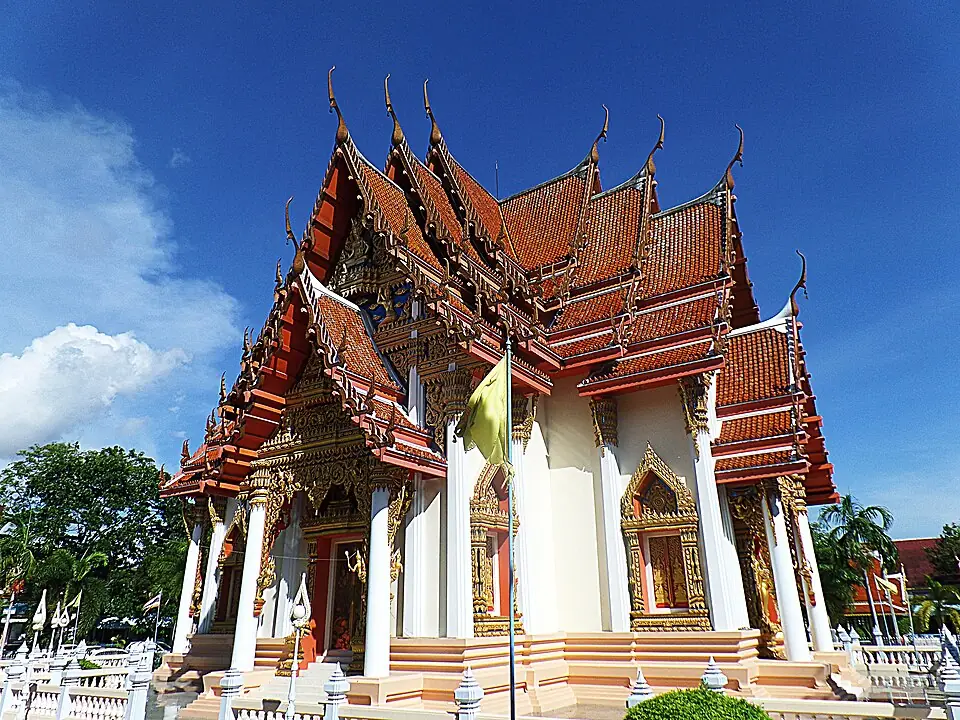
The new ordination hall of Wat Lum Mahachai Chumphon, Rayong · Photo: Panupong Chonswat · CC BY-SA 3.0 via Wikimedia Commons Wat Lum Mahachai Chumphon is in the centre of Rayong. In its grounds are a shrine to King Taksin the Great and a large satue tree to which, it is said, his war elephant was once tethered. The King Taksin the Great Learning Park is next door. The old town around Yomchinda Road is not far away, where you can walk among old wooden houses and visit the Rayong City Museum.
Places to visit nearby
- Wat Lum Mahachai Chumphon and the King Taksin shrine ↗Google Maps
- Yomchinda Road, Rayong old town ↗Google Maps
- Wat Pa Pradu ↗Google MapsThe Tha Pradu area mentioned in the chronicles
- Rayong travel guidesongkran.com
Where to eat nearby
- Cafés and restaurants in old houses on Yomchinda Road ↗Google Maps
- Ban Phe Market ↗Google MapsDried seafood and gifts to take home
- Restaurants around this stop ↗Google Maps
- 2
Klaeng (Wat Ratcha Banlang)
Places to visit nearby
- Wat Ratcha Banlang, Klaeng ↗Google Maps
- Rayong travel guidesongkran.com
Where to eat nearby
- Restaurants around this stop ↗Google Maps
- 3
Prasae estuary
Places to visit nearby
- Thung Prong Thong mangrove, Prasae ↗Google Maps
- Rayong travel guidesongkran.com
Where to eat nearby
- Restaurants around this stop ↗Google Maps
- 4
Bang Kacha
Places to visit nearby
- Wat Phlap, Bang Kacha ↗Google Maps
- Chanthaburi travel guidesongkran.com
Where to eat nearby
- Restaurants around this stop ↗Google Maps
- 5
Chanthaburi
Fighting (not the Burmese)- Battle
- The capture of Chanthaburi
- Against
- The forces of the governor of Chanthaburi; not Burmese troops
- How
- Before the attack Phraya Tak ordered the rice pots and curry pots to be smashed: the men would eat breakfast inside the town. He then attacked the town by night.
- Outcome
- Took Chanthaburi in a single night, captured junks at Trat, and built more than 100 warships to sail back and recover the capital.
- Note
- Approximate position.
Places to visit nearby
- King Taksin Shrine, Chanthaburi ↗Google Maps
- Chanthaboon waterfront community ↗Google Maps
- Chanthaburi travel guidesongkran.com
Where to eat nearby
- Restaurants around this stop ↗Google Maps
- 6
Thung Yai (Trat)
Approximately the area of Trat town
Places to visit nearby
- Things to do in Tratsongkran.com
Where to eat nearby
- Where to eat in Tratsongkran.com
- Restaurants around this stop ↗Google Maps
Travel guides for the provinces on this route
Things to do and where to eat in each province, from songkran.com, our sister travel site
- RayongStop 1, 2, 3Rayong travel guide →
- ChanthaburiStop 4, 5Chanthaburi travel guide →
- TratStop 6Things to do in Trat →Where to eat in Trat →
Where historians still disagree
- The date of the attack: Silpa Wattanatham's date calculation gives the night of 1 June 1767; some English-language works use 15 June.
- Were the rice pots really smashed? The story comes from the royal chronicle and is used to show Phraya Tak's resolve. No other evidence confirms the details.
Frequently asked questions
What does "smashing the rice pots" mean?
The royal chronicle says that before attacking Chanthaburi, Phraya Tak ordered the rice pots and curry pots smashed: the men would eat breakfast inside the town, and if they failed to take it they would die together.
Where did King Taksin build his fleet?
At the Ban Samet Ngam shipyard, Chanthaburi, where more than 100 warships were built.
Last updated 13 November 2026