Home › Biography
The life of King Taksin the Great: an easy-to-read account
King Taksin the Great, also called the King of Thonburi, was the only king of the Thonburi kingdom. He began as an official with the title Phraya Tak, broke out of Ayutthaya through the Burmese siege three months before the city fell, gathered forces at Rayong and Chanthaburi, and then came back with a fleet and recovered the capital within 7 months of its fall. He then spent 15 years bringing a country split into several factions back together, and extended his power to Lanna, Lan Xang and Cambodia. This page sums up his life in order of time, and says which stories come from the chronicles, which are legend, and where historians still disagree.
Born in Ayutthaya
King Taksin was born in Ayutthaya on 17 April 1734, as generally accepted, in the reign of King Borommakot, when Ayutthaya was at peace and flourishing in trade and in Buddhism. His father was a Teochew Chinese of the Tae clan, Zheng in Mandarin, who collected taxes for the court. His mother was named Nok-iang and was later given the title Krom Phra Thepphamat. Chinese documents call him Zheng Zhao.
The traditional account says that Chaophraya Chakri (Mut), a senior official, took the boy in as an adopted son and named him Sin. There is no evidence of where in the city the family home stood, so the map on this site does not pin that spot.
Schooling, service as a page, and Phraya Tak
At about the age of 9 the boy Sin was sent to study under Phra Achan Thongdi at Wat Kosawat, today's Wat Choeng Tha, on the city canal across from the Royal Palace. He was later presented at court as a royal page, and is said to have studied Chinese, Vietnamese and other languages as well. On reaching the age for ordination he was ordained and studied at the same temple for about three years. The stories of these years come from accounts compiled later and do not appear in the royal chronicles.
After leaving the monkhood, Sin returned to royal service in the reign of King Ekkathat. He became Luang Yokkrabat of Tak and then Phraya Tak, the governor of Tak, and it is by this title that Thais came to call him. When the Burmese armies came in 1765–1766, Phraya Tak was called in to defend the capital and was appointed Phraya Wachiraprakan, governor of Kamphaeng Phet, but he never went up to take the post because of the war. The first appearance of the name Phraya Tak differs from one document to another. The Testimony of the Old Capital's People says that from 1764 he was a commander in the army of Phraya Phiphat Kosa, sent to meet the Burmese at Mergui and Tenasserim; the Phra Phonnarat version of the chronicle says that in 1765 he was in the reserve sent to fight the Burmese at Pak Nam Prasop. Silpa Wattanatham magazine notes that Phraya Tak's early role in the chronicles is not a heroic one, until the moment he decides to leave the capital.
The siege and the breakout
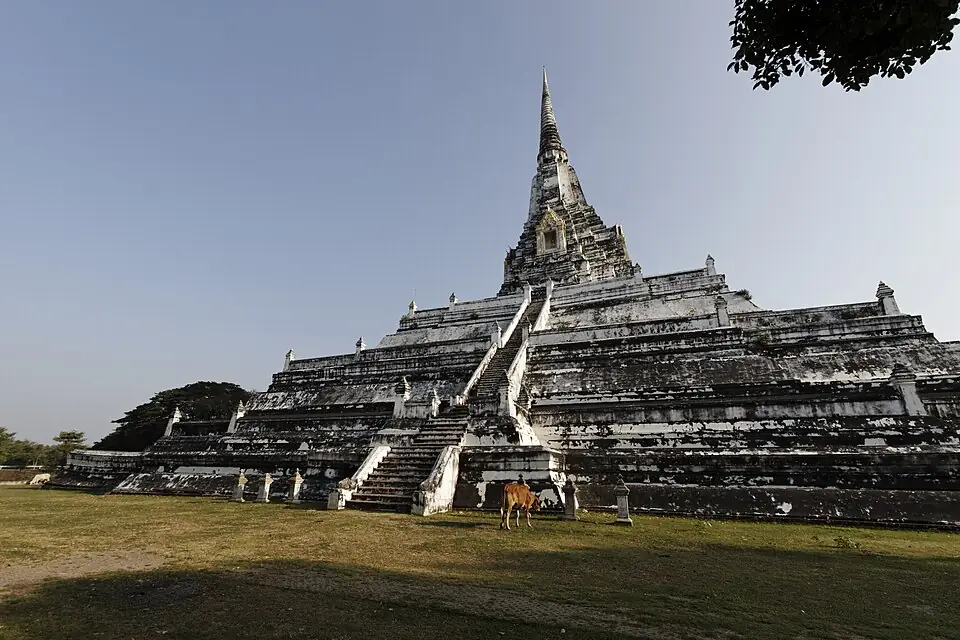
King Hsinbyushin's Burmese armies reached the outskirts of Ayutthaya early in 1766 and besieged the city for about 14 months. Late in January 1766 Phraya Tak and Phraya Phetchaburi went out to fight on the plain by Wat Phu Khao Thong, but were beaten. In November, at the height of the floods, the two had their flotilla stationed at Wat Yai Chai Mongkhon and went to fight at Wat Sangkhawat. Phraya Phetchaburi's force was surrounded and broken, and he was killed; the chronicles record that Phraya Tak's force did not go to his aid. After that fight Phraya Tak moved his camp to Wat Phichai.
On the evening of Saturday 3 January 1767, Phraya Tak led some 500–1,000 Siamese and Chinese soldiers out through the Burmese siege lines from Wat Phichai, east along Khlong Khao Mao. The next evening, at Ban Khao Mao, they could see the fire in the city. They then beat the Burmese at Ban Pho Sao Han and Ban Phran Nok, marched through Nakhon Nayok, Prachin Buri, Pak Nam Cho Lo and the Chonburi coast, and reached Rayong on 27 January, where on 29 January they beat off the group of Rayong officials who came to raid their camp.
Old documents record the events of these months under BE 2309, because the new year then began around April. This site uses the modern reckoning, in which January–March 1767 falls in BE 2310.
Chanthaburi: smashing the rice pots
At Rayong Phraya Tak negotiated with the governor of Chanthaburi to join in recovering the kingdom, and made contact with Phraya Rachasetthi, the ruler of Phutthaimat (Ha Tien). In the meantime Ayutthaya fell, on 7 April 1767, and the country broke up into several factions: Suki's at Pho Sam Ton, those of Chaophraya Phitsanulok, Chao Phra Fang, the ruler of Nakhon Si Thammarat and the Prince of Phimai, and the governor of Chanthaburi, who now turned against Phraya Tak.
Phraya Tak marched from Rayong through Klaeng and reached Chanthaburi at the end of May, camping at Wat Kaeo. The governor of Chanthaburi tried several ruses, but Phraya Tak saw through them. The royal chronicle says that early in the evening before the attack he told the soldiers to eat, then to throw away the leftover food and smash the rice pots and curry pots: they would have breakfast in the town, or else die together. In the middle of the night of 1 June 1767 Phraya Tak's force took Chanthaburi, and its governor fled to Phutthaimat. Phraya Tak then attacked the fleet of Chinese junks at Thung Yai, in Trat territory, and built more than 100 ships at the Ban Samet Ngam shipyard.
The recapture at Pho Sam Ton and the founding of Thonburi
On 23 September 1767 Phraya Tak left Chanthaburi with a fleet of about 100 boats and some 5,000 men. On 22 October he took Thonburi, held by Nai Thong In, whom the Burmese had left in charge of the town, then went up and attacked the Pho Sam Ton camp, north of Ayutthaya, on 25–27 October, until Suki surrendered or, according to some versions, fought to the death. The capital was thus recovered within 7 months of its fall.
After taking the camp, Phraya Tak had the body of King Ekkathat exhumed and cremated, and brought down the members of the royal family who had fled to Lopburi and provided for them, but he did not restore the old capital. On 6 November 1767 he went down to make Thonburi the new capital: it was near the sea, well placed for trade, and easier to defend. On 28 December 1767 he was crowned king. That is why this date is King Taksin the Great Day, with homage ceremonies held every year.
15 years of reuniting the country
In the first year of the reign he beat a Burmese army at Bang Kung, in Samut Songkhram territory. In 1768 he went up against the faction of Chaophraya Phitsanulok, but was hit in the shin by a gunshot in the fighting at Koei Chai and had to withdraw; he then put down the faction of the Prince of Phimai. In 1769 he subdued the faction of the ruler of Nakhon Si Thammarat, and in 1770 that of Chao Phra Fang at Sawangkhaburi. A country that had broken into factions was thus brought together again within about three years.
The wars then spread beyond the borders. In 1771 he took a fleet to attack Phutthaimat and went on into Cambodia. In 1774 he took Chiang Mai together with Phraya Chaban and Phraya Kawila, which freed Lanna from Burmese rule, and late in the same year he surrounded a Burmese army at Bang Kaeo, Ratchaburi, until it surrendered. In 1775–1776 he met the great invasion of Maha Thiha Thura (Azaewunky), who besieged Phitsanulok, where Chaophraya Chakri and Chaophraya Surasi held the city. And in 1778–1779 Chaophraya Chakri's army took Vientiane and brought the Emerald Buddha and the Phra Bang to Thonburi.
Most of the work of this reign went on alongside the rebuilding of the country after the war: finding rice to feed a starving population, trade with China and the coastal towns, collecting the Tripitaka and restoring the monastic order, and literary work such as the Ramakian dance-drama text that the king composed himself.
The end of the reign and his death
For the last years of the reign, the letters of French missionaries and the chronicles tell of a change in the king's condition, including the punishment of officials and monks who would not accept that he had attained enlightenment. Early in 1782, while Chaophraya Chakri was leading an army to Cambodia, Phraya San rebelled and seized Thonburi in a single night. King Taksin agreed to enter the monkhood at Wat Chaeng (Wat Arun). When Chaophraya Chakri returned he put down the rebellion, and King Taksin was executed, as generally accepted on 7 April 1782, at Wichai Prasit Fortress. Chaophraya Chakri came to the throne as King Rama I and moved the capital to the east bank of the river, as Rattanakosin.
There are several other accounts. The Vietnamese chronicle says he was executed at Wat Chaeng, and there is a belief that he did not die but went to live at Nakhon Si Thammarat, another man having been executed in his place. No contemporary evidence confirms these stories, but they show how attached later generations have been to him. His ashes and those of his queen are believed to be enshrined in the twin chedis at Wat Intharam Worawihan, on the Thonburi side.
"The Great" to the Thai people
The cabinet conferred on him the title "the Great" (Maharat) in 1981. The 20-baht banknote of the series issued on 28 December 1981 carries a picture of his monument at Chanthaburi, and the equestrian monument at Wongwian Yai, Bangkok, was unveiled on 17 April 1954. Shrines and monuments to him stand all over the country, from Tak, Rayong, Chanthaburi and Trat to Ayutthaya, at the Ban Phran Nok Memorial in Uthai district, where a ceremony commemorating the breakout is held every 4 January.
Where historians still disagree
- Flight or orders: the Thai chronicles tell the breakout as Phraya Tak's own decision, but some foreign sources suggest he may have gone out on the king's orders, to find forces to relieve the capital.
- The fate of Suki: some versions say he died in the Pho Sam Ton camp, others that his life was spared and he then fled to Phimai.
- Where he stayed after the recapture: some versions say the Pho Sam Ton camp, others the Song Puen Throne Hall in the Royal Palace, where he dreamt that the former kings came to drive him out.
- The date Chanthaburi was taken: the date calculation published in Silpa Wattanatham gives the night of 1 June 1767; some English-language works use 15 June.
- The end of the reign: the Thai chronicles say he was executed, with the date given varying between 7 and 10 April 1782; the Vietnamese chronicle and other beliefs tell it differently.
Visiting information
- One day in his footsteps in Ayutthaya: start at Wat Choeng Tha, then the Royal Palace, Wat Phu Khao Thong, Wat Yai Chai Mongkhon and Wat Phichai Songkhram, and go on to the Ban Phran Nok Memorial.
- In his footsteps in the east: Wat Yai Intharam in Chonburi, Wat Lum Mahachai Chumphon in Rayong and the King Taksin shrine at Chanthaburi.
- In his footsteps in Thonburi: the Thonburi Palace (Phra Racha Wang Doem), Wat Arun Ratchawararam, Wat Intharam Worawihan and the royal monument at Wongwian Yai.
Frequently asked questions
When was King Taksin born?
On 17 April 1734 (BE 2277) in Ayutthaya, as generally accepted.
Why is he called "King Tak" (Phra Chao Tak)?
Because before he became king he was Phraya Tak, the governor of Tak, so Thais call him by his old title. Sin was his personal name.
When did King Taksin recover the capital?
In late October 1767, when he took the Pho Sam Ton camp, about 7 months after the fall of the city. He went down to found Thonburi on 6 November 1767.
What is 28 December?
King Taksin the Great Day, the anniversary of his coronation at Thonburi on 28 December 1767. It is not a public holiday.
Where did the smashing of the rice pots happen?
At Chanthaburi, before the attack on the town on the night of 1 June 1767, as the royal chronicle tells it.
Notes
- The boy Sin's age when he began his studies at Wat Kosawat: this page uses "about 9", following the book Aphinihan Banphaburut, the old text that gives his age: "when he was 9 years old, Chaophraya Chakri took the boy to the care of Phra Achan Thongdi". Some sources, such as the English Wikipedia, say 7. None of these childhood stories appears in the royal chronicles.
- From Ayutthaya to Thonburi: A chronology of key events in the life of King Taksin – Silpa Wattanatham (in Thai)
- Taksin - Wikipedia
- Foreign evidence on the last days of Ayutthaya: Phraya Tak broke out "on orders" – Silpa Wattanatham (in Thai)
- Phraya Tak's unflattering first appearance – Silpa Wattanatham (in Thai)
- Testimony on the day "King Taksin" was executed, the last scene of Thonburi – Silpa Wattanatham (in Thai)
- King Taksin the Great – KMUTT Library (in Thai)
- The life of King Taksin from the book Aphinihan Banphaburut - Wikisource (Thai)
Last updated 13 November 2026