Home › Places › Wat Phu Khao Thong
Wat Phu Khao Thong and its plain: Phraya Tak's first battlefield in the war of the fall
Wat Phu Khao Thong stands in the middle of a wide plain north of Ayutthaya's city island, its tall chedi a landmark visible from far away. In the war of the second fall this plain was one of the first battlefields where Phraya Tak fought. When the Burmese armies reached the outskirts of the capital early in 1766, Phraya Phetchaburi and Phraya Tak went out to fight on the plain by Wat Phu Khao Thong, but were beaten back, and some months later the Burmese commander moved his camp into this area to close in on the city.
This place through the periods
A great chedi in the fields north of the city. In 1744 King Borommakot had it restored, and its upper part became a Thai-style chedi with twelve redented corners on the original Mon-Burmese-style base. At the time the young Sin was still a boy in the city.
At the end of January 1766, when the Burmese armies reached the outskirts of the capital, Phraya Phetchaburi (Rueang) and Phraya Tak went out to fight on the plain by Wat Phu Khao Thong, but were beaten back. According to works based on the Burmese chronicles, in September 1766 the Burmese commander Maha Nawrahta moved his camp to the area of Wat Phu Khao Thong and placed his vanguard at Wat Tha Ka Rong, about 500 metres from the city wall.
The Phu Khao Thong plain was part of the line of Burmese camps that besieged the city until it fell. After the Burmese withdrew, the plain lay waste for several years.
In the Thonburi years the Phu Khao Thong plain went back to being the rice fields of villagers who gradually returned. The chedi still stood out in the middle of the fields, a landmark of the old city.
Wat Phu Khao Thong still has monks in residence, and you can climb the chedi's stairs for a view over the fields. Nearby on the plain are the royal monument to King Naresuan the Great and an open ground where provincial events are held.
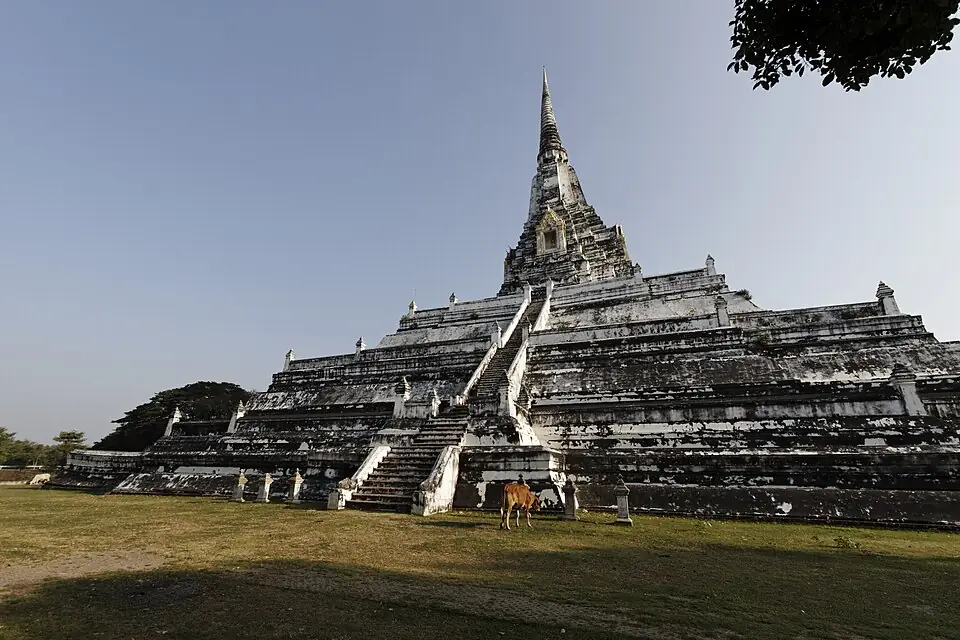
A chedi in the fields north of the city
The chronicles record that Wat Phu Khao Thong was founded in 1387. The base of the chedi is Mon-Burmese in style, which tradition ties to King Bayinnaung building a chedi here after his victory in 1569, though scholars still disagree about the age of the base. Later, in 1744, King Borommakot had it restored, and the upper part became a Thai-style chedi with twelve redented corners.
The Phu Khao Thong plain is a wide stretch of level ground north of the city, the route that armies coming from the north and west usually took to close in on it. Several of Ayutthaya's great battles were therefore fought on this plain.
Phraya Tak's first battle on the Phu Khao Thong plain
Early in 1766 Ne Myo Thihapate's army, coming down from the north, reached the outskirts of the capital. The court sent Phraya Phetchaburi (Rueang) and Phraya Tak out to meet it on the plain by Wat Phu Khao Thong, but the Siamese were beaten and fell back into the city. This battle led the court to rely mainly on defending from inside the city.
Studies based on the Burmese chronicles say that in September 1766 Maha Nawrahta moved his camp from Si Kuk to the area of Wat Phu Khao Thong and placed his vanguard at Wat Tha Ka Rong, about 500 metres from the city wall. The Siamese tried to take the Wat Tha Ka Rong camp in December, without success. The plain thus became the north-western side of the ring that squeezed the city until the day it fell.
From battlefield to the city's event ground
After the war the Phu Khao Thong plain went back to being villagers' rice fields, with the chedi still standing out in the middle. Today you can climb its stairs for a view of the fields all around, and nearby on the plain is the royal monument to King Naresuan the Great, completed in 1999. This open ground is used for several of the province's major events.
For anyone following in King Taksin's footsteps, this plain is the place that shows most clearly how hard the war of the fall was. Stand on the chedi and look towards the city island: these 2 kilometres are the distance over which the Burmese moved their camps, little by little, closer to the city wall over many months.
Phraya Tak's name in the chronicles at this point
The royal chronicles first mention Phraya Tak in the fighting of this same period, when the Ayutthaya army went to attack the Burmese camp at Pak Nam Prasop but was outmanoeuvred, enveloped and driven back as far as the Pho Sam Ton area. Those who broke and fled rode their horses across the river, where Phraya Tak's men were waiting and fighting, helping them to cross first and then crossing after them. Not long afterwards Phraya Tak went out to fight on the Phu Khao Thong plain.
On this site's one-day trip in King Taksin's footsteps, the Phu Khao Thong plain comes in the late morning, after Wat Choeng Tha, which is not far away. The fields around the temple are open with little shade, so it is best to come in the morning or late afternoon.
Where historians still disagree
- Who built the Mon-Burmese-style base of the chedi: tradition says King Bayinnaung built it after the war of 1569, but some studies hold that the base is older.
- Where Maha Nawrahta's camp stood: works based on the Burmese chronicles say he moved to the area of Wat Phu Khao Thong, while the Thai chronicles give different details of the camps around the city.
Visiting information
- The open plaza gets extremely hot in the middle of the day, so bring a hat, an umbrella and drinking water.
- The chedi's stairs are steep: wear shoes with a good grip and take your time.
- Combine it with Wat Na Phra Men and Wat Choeng Tha, which are also outside the city island to the north.
Frequently asked questions
When did Phraya Tak fight at Wat Phu Khao Thong?
At the end of January 1766 (BE 2309). When the Burmese armies reached the outskirts of the capital, Phraya Phetchaburi and Phraya Tak went out to fight, but were beaten back.
Can you climb the Phu Khao Thong chedi?
Yes. Stairs lead up to the circumambulation terrace. Take care, as they are steep.
Last updated 13 November 2026