Home › History › The war of the second fall of Ayutthaya
The second fall of Ayutthaya: the war from its beginning to the fall of the city
The war of the second fall began with King Hsinbyushin's Burmese armies, which set out by two routes from 1764, met at Ayutthaya early in 1766 and then besieged the city for about 14 months. This time the Burmese did not withdraw in the flood season. They built permanent camps and tightened the ring until the wall was breached at Maha Chai Fortress on the night of 7 April 1767. Phraya Tak was in this war from the start, until he broke out through the siege early in January 1767.
Two armies
King Hsinbyushin sent two armies at the same time. The northern army under Ne Myo Thihapate first subdued Lanna and Luang Prabang, then came down against the northern towns. The southern army under Maha Nawrahta came in by way of Tavoy, took Mergui and Tenasserim, then crossed over and based itself at Kanchanaburi. On the way the Burmese armies attacked the towns along their routes and gathered supplies. The Siamese sent forces to meet them at several points but could not stop them. The Testimony of the Old Capital's People says Phraya Tak was a commander in the army sent to hold the Mergui and Tenasserim side from the start of the war.
Late in 1765 the Burmese won at Nonthaburi, and in January 1766 Ne Myo Thihapate beat the Siamese army at Pak Nam Prasop and reached the outskirts of the capital. At the end of that month Phraya Phetchaburi and Phraya Tak went out to fight on the plain by Wat Phu Khao Thong, but lost.
A siege without retreat
In earlier wars the armies besieging Ayutthaya usually had to withdraw when the floods came, so the court hoped it would be the same this time. But Maha Nawrahta declared that Ayutthaya was like a fish caught in a net, and had his soldiers grow rice around the city, build boats and set up camps on high ground. In September 1766 Maha Nawrahta moved to the area of Wat Phu Khao Thong, and Ne Myo Thihapate moved to Pho Sam Ton.
In November, at the height of the floods, the court had Phraya Tak, Phraya Phetchaburi and Luang Son Seni station a flotilla at Wat Yai Chai Mongkhon to intercept the Burmese boats. Phraya Phetchaburi took his boats into the attack, was surrounded and was killed. The Royal Autograph version of the chronicle says Phraya Tak and Luang Son Seni kept their boats moored and looked on without going to his aid, then withdrew to Wat Phichai. The court bricked up the city gates and called on the Chinese and the Portuguese to help in the fighting.
The dry season of 1767: the ring tightens
Early in January 1767 Phraya Tak broke out through the siege to the east. The Burmese built about 27 fortified towers around the city with bricks taken from temples, and in March they overran the Chinese camp at Khlong Suan Phlu, the camp at the Portuguese settlement and the stronghold at Wat Chaiwatthanaram. Maha Nawrahta died of illness during the siege, so Ne Myo Thihapate was left in sole command.
At the end of March the Burmese set up camp on the Hua Ro side, built a bridge across the river and dug tunnels under the wall at Maha Chai Fortress. On the afternoon of 7 April they lit fires under the wall. By nightfall the wall had collapsed, and the Burmese broke into the city at about midnight.
After the fall
The city was looted and burned. Great numbers of people were carried off to Burma, among them King Uthumphon and many other members of the royal family. King Ekkathat died, in a way the Thai and Burmese chronicles tell differently. The main Burmese army withdrew because it had to meet the Chinese invasion, leaving Suki to hold the Pho Sam Ton camp. 7 months later King Taksin came back and took that camp.
Where historians still disagree
- How King Ekkathat died: the Thai chronicles say he starved after fleeing to Ban Chik, near Wat Sangkhawat; the Burmese chronicles say he was shot at a city gate.
- Who burned the city: some scholars point out that part of the damage came from digging for valuables after the war, and not all of it from the Burmese.
Places on the map linked to this period
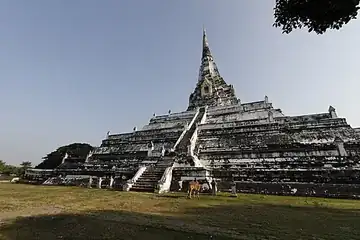 TempleWat Phu Khao Thong★The plain where Phraya Tak went out to fight the Burmese early in the war, and where the Burmese commander later set up his camp
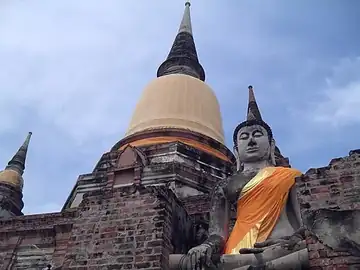 TempleWat Yai Chai Mongkhon★Where Phraya Tak and Phraya Phetchaburi stationed their flotilla during the floods at the end of 1766TempleWat Sangkhawat★The river battlefield where Phraya Phetchaburi was killed, in the fight that changed Phraya Tak's mind about defending the city
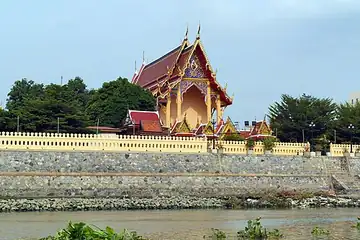 TempleWat Phichai Songkhram★Phraya Tak's last camp at Ayutthaya, and the starting point of his breakout through the Burmese siege on 3 January 1767Fort / campMaha Chai Fortress, Hua RoThe corner of the wall the Burmese undermined with tunnels and fire until it collapsed on the night the city fell, 7 April 1767
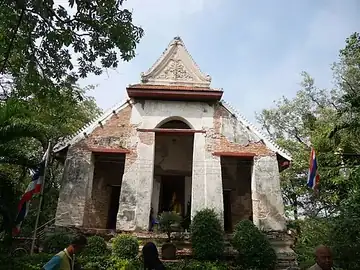 TempleWat Mae Nang PluemThe bank opposite Maha Chai Fortress where the Burmese camped to attack the city; what remains is Khok Phama, the "Burmese Mound", near the templeFort / campPho Sam Ton camp★The main Burmese camp north of the city, which King Taksin retook at the end of October 1767
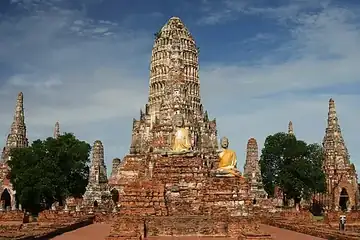 TempleWat ChaiwatthanaramThe riverside temple on the west bank that served as a stronghold on the southern side, holding out against the Burmese for nine days before it fell
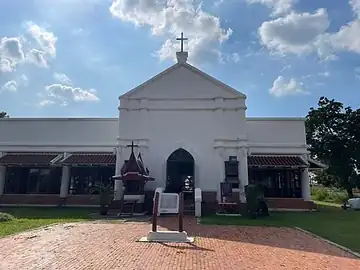 CommunityPortuguese SettlementThe Portuguese community whose camp fell in March 1767; some of its soldiers went on to serve in King Taksin's army
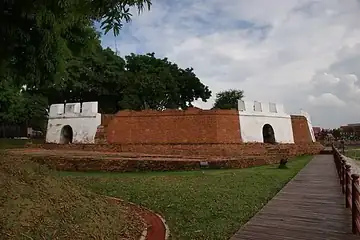 Fort / campPhet FortressThe river-mouth fort at the south-east corner, on the side where the Chinese volunteers' junks were trapped by a Burmese iron chain
Frequently asked questions
How long did the Burmese besiege Ayutthaya?
About 14 months, from early 1766 to 7 April 1767.
Where did the Burmese break into the city?
At Maha Chai Fortress, at the north-east corner of the city island, at Hua Ro.
- Siege of Ayutthaya (1766–1767) - Wikipedia
- Tunnelling and burning the wall: towards the end of Ayutthaya – Silpa Wattanatham (in Thai)
- "Building a pen around the cattle": the Burmese tactic that broke Ayutthaya – Silpa Wattanatham (in Thai)
- How the Burmese army took the captives of Ayutthaya to Ava – Silpa Wattanatham (in Thai)
Last updated 13 November 2026