Home › Places › Wat Phra Si Sanphet
Wat Phra Si Sanphet on the day Ayutthaya fell
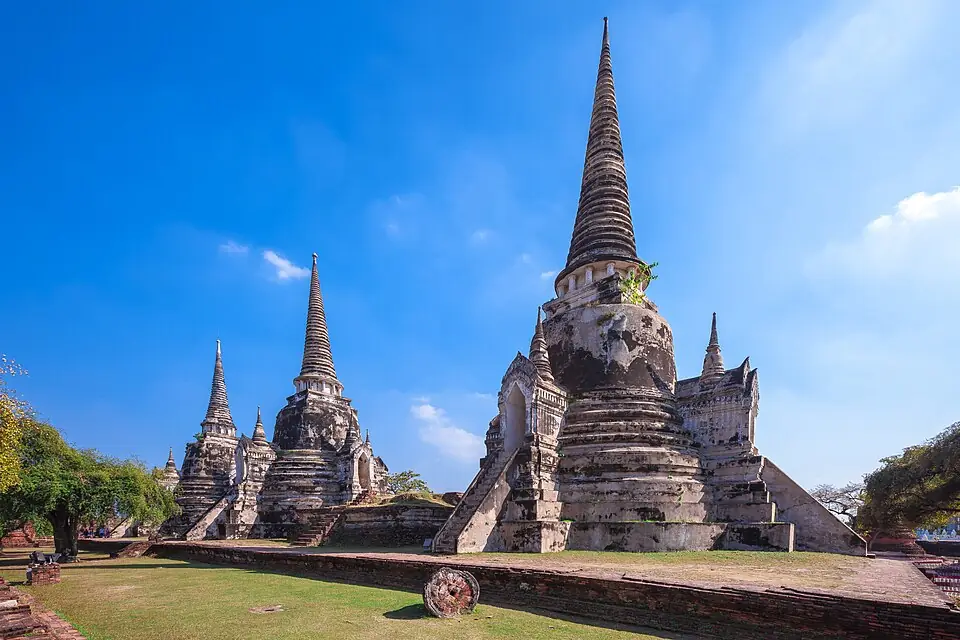
Wat Phra Si Sanphet was the temple within the palace grounds of Ayutthaya. Its three chedis in a row have become the image of Ayutthaya known around the world. As a young man serving at court, Sin, the future King Taksin, must have seen the royal ceremonies at this temple. And on the night the city fell in 1767 it was one of the places most heavily destroyed, when the Burmese burned the wihan and stripped off the gold that covered the Phra Si Sanphet.
This place through the periods
A temple within the palace grounds, used for major royal ceremonies. Its three chedis hold the ashes of kings, and its wihan housed the Phra Si Sanphet, a standing Buddha image about 16 metres tall, covered in gold. As a young man in royal service, Sin must have seen this temple at the court's royal ceremonies.
During the Burmese siege the temple lay within the royal precinct in the middle of the city, out of range of the fighting on the walls, but it was neglected, as people were starving and taken up with the defence of the city.
On the night the city fell, 7 April 1767, the wihan was burned. The Burmese lit fires to strip off the gold that covered the Phra Si Sanphet, and the image was damaged until only fragments were left.
In the Thonburi years the remains of the Phra Si Sanphet were still in the deserted temple. Later King Rama I had the fragments brought down and enshrined in the great chedi at Wat Phra Chetuphon (Wat Pho) in Bangkok.
The three chedis in a row are the emblem of Ayutthaya. They stand within the Ayutthaya Historical Park, a World Heritage Site since 1991.
The court's temple
Wat Phra Si Sanphet had no resident monks, because it was a temple within the palace grounds, used for the royal ceremonies of the court, like Wat Phra Si Rattana Satsadaram in Bangkok today. The three chedis hold the ashes of early kings of the Suphannaphum dynasty. The great wihan housed the Phra Si Sanphet, a standing Buddha image about 16 metres tall, covered all over in gold.
In the reigns of King Borommakot and King Ekkathat, the years when Sin was serving as a royal page, this temple was still the centre of the court's royal ceremonies.
The fire that stripped the gold from the Phra Si Sanphet
When the Burmese broke into the city on the night of 7 April 1767, the temple's wihan was burned. The Burmese lit fires around the Phra Si Sanphet so that the gold covering it would melt and come away, and the image was damaged until only fragments were left. Treasure from the temple and the palace was carried off, along with tens of thousands of captives.
When King Taksin came back and recovered the capital late in the same year, this temple was the picture of how hard it would be to restore the old city. He chose to set up a new capital at Thonburi. The fragments of the Phra Si Sanphet were taken to be enshrined in the great chedi at Wat Phra Chetuphon in the reign of King Rama I.
Visiting Wat Phra Si Sanphet today
The three bell-shaped chedis were restored in the late 1950s and 1960s and have become the emblem of Ayutthaya. The entrance is on the east side. You can walk straight on to the Royal Palace grounds to the north, and cross the road to Wihan Phra Mongkhon Bophit to the south. When the authorities hold evening events, this temple is usually lit up; check the event dates before you go.
Khok Phra Men and King Ekkathat's body
South of Wat Phra Si Sanphet is Wihan Phra Mongkhon Bophit. Thai sources say that after the fall the Burmese buried King Ekkathat's body hastily at Khok Phra Men, in front of Wihan Phra Mongkhon Bophit. After Phraya Tak took the Pho Sam Ton camp late in 1767, he had the body exhumed and cremated.
That cremation carried great political meaning, because it was the duty of a successor to the throne, performed before officials and commoners. As for the cause of King Ekkathat's death, the Thai chronicles say he starved at Ban Chik near Wat Sangkhawat, while the Burmese chronicle says he was shot as he fled through a city gate. You can compare the accounts on this site's chronicles pages.
If you follow this site's one-day trip, Wat Phra Si Sanphet comes after the Royal Palace next door. You can walk between them, and the combined ticket for the historic sites can be used.
Where historians still disagree
- Was the gold melted off the Phra Si Sanphet: the story that the Burmese lit fires to strip the gold on the night of the fall is widely told, but Rungroj Piromanukul challenges it in a book whose Thai title says the image was not burned for its gold when the city fell. What is certain is that the image was too damaged to restore, and King Rama I had it enshrined in a great chedi at Wat Pho.
Visiting information
- Admission: Information updated December 2025: Thai visitors THB 10, foreign visitors THB 80, or a combined ticket for 7 sites in the Historical Park at THB 40 for Thai visitors and THB 300 for foreign visitors (subject to change).
- Dress modestly, with shoulders and knees covered, as this is a religious site.
- Go in the morning or late afternoon, to avoid the strong midday sun.
- Combine it with the Royal Palace to the north, the place to follow King Taksin's years in royal service.
Opening hours and admission fees may change, so please check before you go.
Frequently asked questions
Where is the Phra Si Sanphet Buddha now?
The image was damaged when the city fell. King Rama I had the fragments brought down and enshrined in the great chedi at Wat Phra Chetuphon (Wat Pho) in Bangkok.
Does Wat Phra Si Sanphet have monks?
No, and it has had none since the Ayutthaya period, because it was a temple within the palace grounds, for royal ceremonies.
Last updated 13 November 2026