Home › Places › Wat Na Phra Men
Wat Na Phra Men, Ayutthaya: the temple that survived the fires of the war of the fall
Wat Na Phra Men stands on the north bank of Khlong Mueang, only about 378 metres from the wall of the Royal Palace. In King Taksin's lifetime the temple was caught up in two Burmese wars. The first time, in 1760, King Alaungpaya placed cannon in front of the temple to fire on the palace. The second time, in the war of the fall in 1767, the Burmese used this area as a position, so the temple was not burned when the city fell. Today it is one of the most complete Ayutthaya-period temples left for later generations to see.
This place through the periods
In 1760, when the young Sin was in royal service, King Alaungpaya's army set up its royal camp on the Na Phra Men field and placed cannon in front of this temple to fire on the palace. One of the guns burst and King Alaungpaya was gravely wounded. The Burmese withdrew, and he died on the way, before they were clear of Tak.
In the war of 1766–1767 the temple lay within the line of Burmese camps to the north, with only the canal between it and the palace wall. According to tradition the Burmese used the temple grounds as a position and bombarded the city from it.
When the city fell, many temples close by on the city island were burned, but Wat Na Phra Men was not, because it was a position of the winning side.
In the Thonburi years the temple remained in better condition than most temples in Ayutthaya. Later, in the reign of King Rama III, it underwent a major restoration that kept much of its original form.
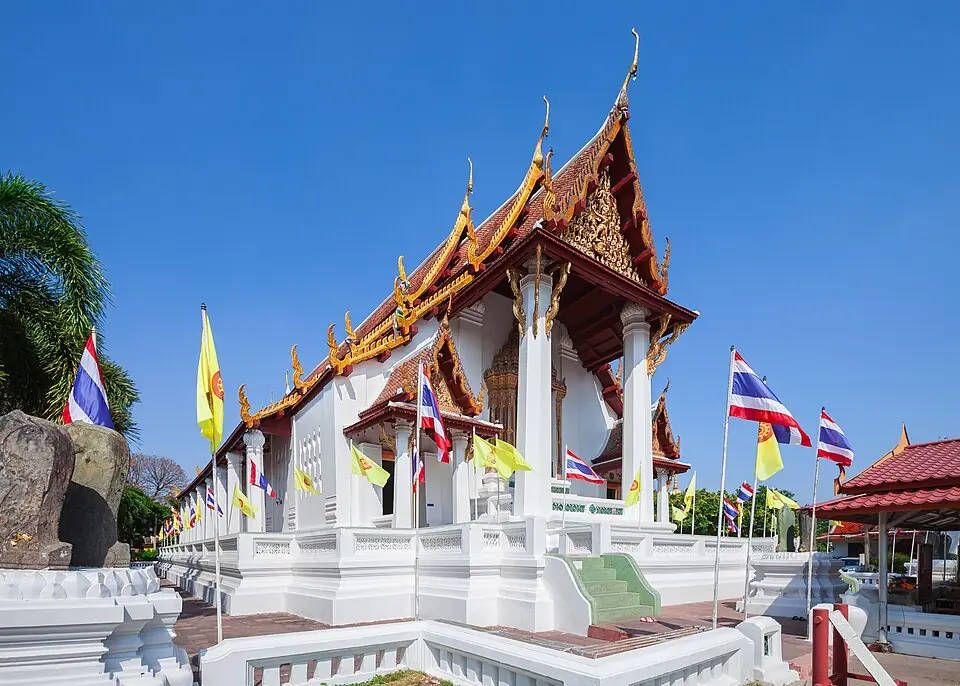
The Ayutthaya-style ubosot is still intact and houses a large crowned Buddha image. The small wihan (Wihan Noi) has the Phra Khanthararat, a Dvaravati-style green-stone Buddha seated with legs pendent.
Alaungpaya's war, 1760
Seven years before the fall, King Alaungpaya of the Konbaung dynasty led an army to besiege Ayutthaya. The royal camp was set up on the Na Phra Men field, and cannon were placed in front of this temple to fire on the palace. One gun burst because the shot jammed in the muzzle, and King Alaungpaya was gravely wounded. The Burmese therefore withdrew, and he died on the way, before the army was clear of Tak. This is a war that the future Phraya Tak probably saw with his own eyes while in royal service.
That victory gave the Ayutthaya court confidence in standing on the defensive inside the city, which became the same strategy used in the next war. But that time the Burmese did not withdraw.
Why this temple was not burned
In the war of 1766–1767 Wat Na Phra Men lay within the line of Burmese camps north of the city. According to tradition, the Burmese used the temple grounds as a position and bombarded the city from it. When the city fell, a great many temples on the city island were burned, but a temple that served as a position of the winning side was not, and so Wat Na Phra Men survived, though it is not the only temple in Ayutthaya that escaped the fire.
Some scholars also point out that not all the damage to Ayutthaya came from burning by the Burmese: demolition and digging for valuables after the war destroyed a great deal of the ancient city as well.
What to see
The ubosot is an intact example of a roofed building of the Ayutthaya period. It underwent a major restoration in the reign of King Rama III, but much of its original form was kept. The carved and gilded wooden pediment shows Vishnu (Narai) riding Garuda. Inside is a large crowned Buddha image, one of the most beautiful of the late Ayutthaya period. The small wihan has the Phra Khanthararat, a Dvaravati-style green-stone Buddha seated with legs pendent, said to have been brought from Wat Mahathat.
Wat Na Phra Men in King Taksin's story
King Taksin was born and grew up in a city that had temples like this in every quarter, but after the fall most of them were left as ruins. Wat Na Phra Men is therefore one of the few places that help you picture an ubosot of late Ayutthaya close to the real thing: its size, the shape of its roof and the placing of the principal Buddha image.
On this site's one-day trip, Wat Na Phra Men comes between Wat Mae Nang Pluem and Wat Choeng Tha. Allow about half an hour for the visit, and dress modestly, as it is a working temple with resident monks.
Where historians still disagree
- Did the Burmese really use this temple as a position in the war of 1767? It is a tradition that fits the fact that the temple escaped the fire, but the chronicles do not say so clearly.
Visiting information
- This is a working temple with resident monks, so dress modestly and behave respectfully.
- Take off your shoes before entering the ubosot and the small wihan, and do not use flash on the Buddha images.
- Combine it with Wat Choeng Tha and the Royal Palace on the opposite bank.
Frequently asked questions
Why was Wat Na Phra Men not burned when Ayutthaya fell?
According to tradition, the Burmese used the temple grounds as a position, so the temple was not burned after their victory.
Was King Alaungpaya really wounded at Wat Na Phra Men?
The story told is that a cannon placed in front of the temple burst in 1760, gravely wounding him, and that he died during the retreat.
Last updated 13 November 2026